WARNING: THE FOLLOWING ARTICLE CONTAINS SPOILERS FOR IT ENDS WITH US BY COLLEEN HOOVER
I never expected to say this, but I may written off a Colleen Hoover project too soon.
On May 16, Sony Pictures Entertainment released the first trailer for the upcoming film adaptation of Hoover’s bestselling 2016 novel It Ends With Us. The trailer, soundtracked by “My Tears Ricochet” by Taylor Swift, begins with a vision of the whirlwind romance between Lily Bloom (Blake Lively) and Ryle Kincaid (Justin Baldoni) as Lily postulates about the vision of love and romance “everybody has.”

“But fifteen seconds is all it takes to completely change everything,” Lily says before the tone shifts to the dark reality of her relationship with Ryle. There are shots of Ryle smashing an object on the floor and Lily looking into the mirror at a bite mark over a tattoo on her collarbone, a reference to a scene in the novel where Ryle bites Lily hard enough to break skin before attempting to rape her. It’s clear this film won’t pull any punches when it comes to the more difficult scenes from the novel, but I can’t help but remain skeptical.
It Ends With Us is the only one of Hoover’s 26 novels I’ve personally read, and I don’t intend to read any more of her work. As both a witness to and survivor of domestic violence, I didn’t feel empowered or inspired by this story. While the book occasionally provides good insight into how cycles of violence are perpetuated, I found it overall offensive, exploitative and condescending. Hoover puts more work into romanticizing the abusive lead than actually building the characters or their relationships, and the extent to which she provides excuses for Ryle’s abuse is appalling. Furthermore, her prose is simplistic and over-explanatory to the point it doesn’t feel like she trusts her audience to understand her story if she doesn’t hold their hands through it. Any deep analysis I’ve seen of any of her other work doesn’t suggest the rest of her catalogue is any different, and any other attempt I’ve made at reading her further work failed.
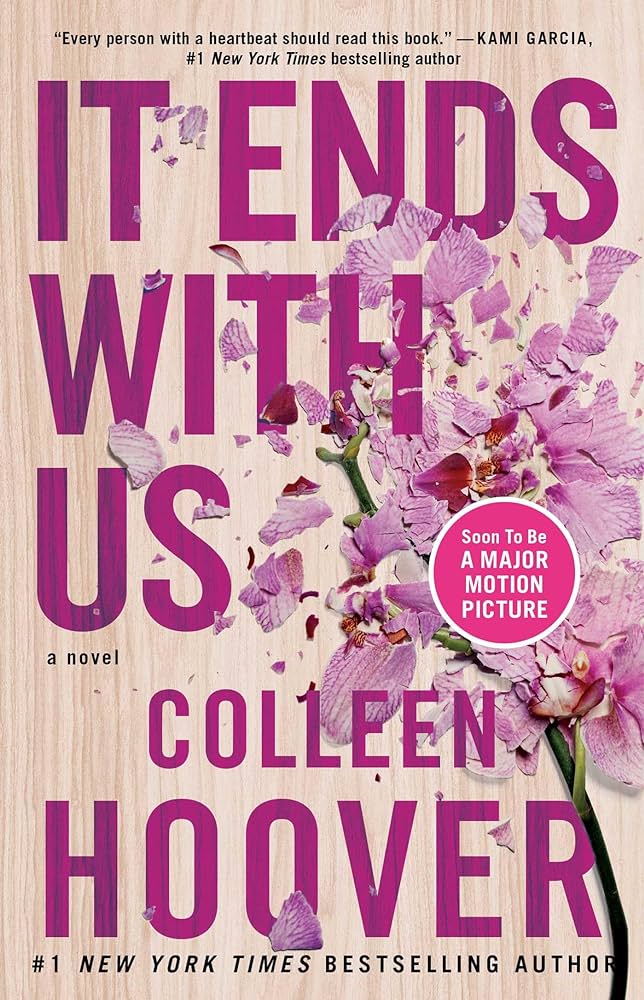
Yet, based on the first official trailer, Baldoni and screenwriter Christy Hall may have done the impossible by adapting this awful book into a halfway-decent film.
Some fans of the novel complained the entire plot was in the trailer. This is not only objectively incorrect but, in my opinion, irrelevant. One of the biggest issues that has always plagued It Ends With Us is marketing. The story is about domestic abuse, which is made abundantly clear in the film’s trailer but is treated like a shocking mid-point plot twist by the source material. The novel is marketed as a “complicated romance,” with the only allusion to its darker subject matter being the header on the back of the book which reads: “SOMETIMES THE ONE WHO LOVES YOU IS THE ONE WHO HURTS YOU THE MOST.” Even so, that is undermined by the copy that states the appearance of an old flame threatens “everything Lily has built with Ryle”, rather than Ryle’s abusive behavior. In fact, it almost implies Ryle would not abused Lily if not for Atlas’s reappearance.
Ryle is described in the summary as “assertive, stubborn” and “maybe even a little arrogant.” The only thing described as “disturbing” is his “complete aversion to relationships,” rather than any of his behavior leading up to or including physical abuse. While Ryle does exhibit controlling behavior before he and Lily ever get together, including one delightful scene where he essentially kidnaps Lily by locking her in his bedroom, this behavior is not intended to be seen as a red flag. Similarly, the opening scene where Ryle is seen destroying patio furniture in a barely-controlled rage is seen by the main character as enviable, rather than concerning.

There’s never a point where Lily looks back on this encounter and recontextualizes it as an early sign of his present abuse. These moments occur when Ryle is still supposed to be seen as the ideal romantic lead as if it’s charming for a man to lock a woman in a room, ignore her when she says “no” or beg on his knees for sex. I can only see the blunt inclusion of Ryle’s abuse in the trailer as a good thing. Marketing this film in the same way the book was marketed would be disingenuous and, frankly, scummy. If you ask me, anyone with a personal history of domestic violence who picked up this book thinking it was a romance novel was done a great disservice. At least those who watch the movie without having read the source material won’t be going in blind.
Fans complaining about the casting are also, in my opinion, wrong. In the book, Ryle and Lily are 29 and 23, respectively. Yet, Ryle is about to finish his residency to become a neurosurgeon and Lily has enough capital as a recent college graduate to open her own flower shop without so much as a business plan.
According to the Cleveland Clinic, “It takes approximately 14 to 16 years to become a neurosurgeon, including pre-med (undergrad) education, medical school, internship and residency. Neurosurgeons undergo one of the longest training periods of any medical specialty due to the complexity of the field of medicine.” Unless Ryle graduated high school between the ages of thirteen and sixteen, a feat which would surely have been an important detail to include, it’s unlikely he’d be about to finish his studies at this age.
This is a change even Hoover herself has expressed support for, as she admitted the characters’ ages relative to their professions was an oversight on her part.

“Back when I wrote It Ends With Us, the new adult [genre] was very popular,” Hoover told The Hollywood Reporter. “You were writing college-age characters. That’s what I was contracted to do. I made Lily very young. [sic] There’s not a 20-something neurosurgeon. As I started making this movie, I’m like, ‘We need to age them out, because I messed up.’ So, that’s my fault.”
While these changes are promising, I don’t want to give the film too much credit yet. There’s still no telling if they’re going to keep the scene where Ryle locks Lily in his room and undresses her without so much as asking, or how it will be framed if it is. It’s still unknown if Ryle is going to claim blackouts as a reason for his abuse, despite the presence of a scene where he plans and executes a deliberate humiliation for Lily. Hoover is credited as an executive producer and, while she has clearly shown herself to be flexible in terms of plot and cast changes, there’s still no telling what she refused to compromise on.
I’m not going so far as to say they’ve spun straw into gold just yet, but the It Ends With Us film trailer promises the raw, engaging romantic drama the novel should have been. For the time being, Hoover Haters and CoHorts alike will have to wait and see if it makes good on that promise.
It Ends With Us will be released in theaters on August 9, 2024. Check out the full trailer below:
Did you read It Ends With Us? What are your thoughts on the trailer? Let us know in the comments or on social media!
 The In-Crowd